Siegmund
Siegmund is a fellow student and close friend of Nathaniel in E. T. A. Hoffmann's 'The Sandman', a figure of grounded perception and steadfast loyalty who repeatedly tries to warn Nathaniel against his dangerous infatuation with Olympia and who later helps rescue him from the grip of madness. Unlike the other characters who either indulge Nathaniel's fantasies or dismiss them coldly, Siegmund occupies a middle ground: he sees clearly what Nathaniel cannot, speaks his concern with genuine warmth, and remains faithful even after his warnings are rejected. His role is that of the sensible friend whose clarity is powerless against the protagonist's self-destructive obsession, and whose quiet loyalty endures through the catastrophe.
Identity and Introduction
Siegmund first appears in the narrative as a fellow student who calls out to Nathaniel from the street, reminding him that it is time to attend Professor Spalanzani's lecture . He is thus introduced as part of Nathaniel's everyday academic life in the city of G., a peer who moves in the same circles and shares the same routines. Nothing in the text suggests that Siegmund is a fantastical or eccentric figure; on the contrary, he is presented as an ordinary, sensible young man, the kind of friend who notices when something is wrong and does not hesitate to speak up.
Warning Against Olympia
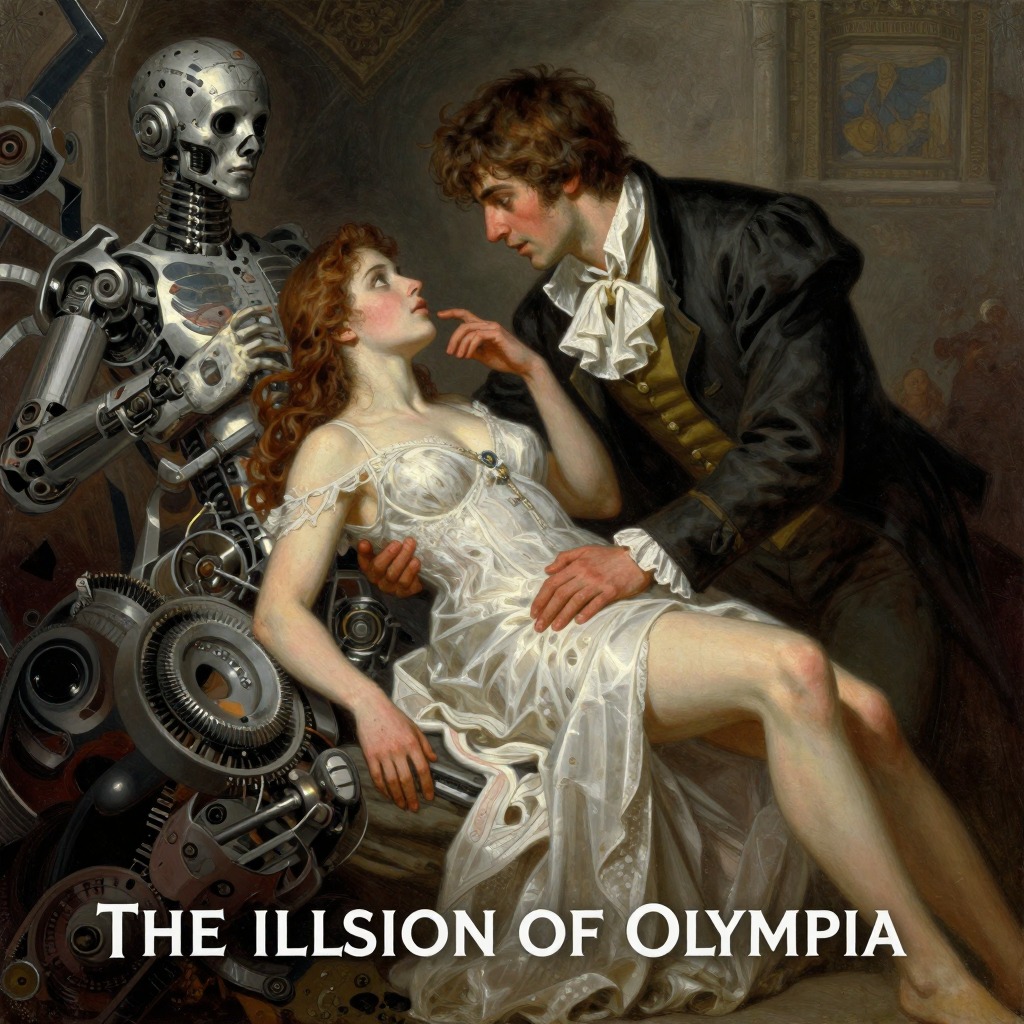
Siegmund's most significant action in the story is his direct warning to Nathaniel about Olympia. After Spalanzani's party, when the town is buzzing with gossip about the strange and silent girl, Siegmund confronts Nathaniel with a blunt question: 'I beg you, my friend, tell me how in heaven's name an intelligent man like you ever fell for the wax face of that wooden doll?' . The question is not malicious; it is the honest bewilderment of a friend who cannot understand how someone he respects has been so thoroughly deceived. When Nathaniel reacts with anger, Siegmund does not press the point but instead offers a more detailed explanation of what he and others have observed: Olympia's strangely stiff and soulless appearance, her gaze devoid of life, her step measured as if by clockwork gears, her playing and singing marked by 'the unpleasantly precise soulless rhythm of a machine' . He concludes with a soft, almost sad warning: 'Beware, my brother, it seems to me you're heading in a dangerous direction. You can count on me, if all else – no, I dare not say any more!' . The unfinished sentence carries the weight of a friend who sees disaster coming but knows he cannot stop it.
Role in the Catastrophe
When Nathaniel's madness finally erupts in Spalanzani's study, Siegmund is among those who rush in to restrain him. The text notes that 'as strong as he was, Siegmund was not able to restrain the madman, who kept on screaming in a terrifying voice: "Wooden doll, turn, turn!" and lashed about him with balled fists' . It takes the combined strength of many men to overpower Nathaniel, tie him up, and take him to the madhouse. Siegmund's physical strength is insufficient against the force of Nathaniel's frenzy, but his presence at the scene confirms his loyalty: he does not abandon his friend even when that friend has become a raving stranger.
Faithful Friend in Recovery
After Nathaniel is brought home and begins to recover from his madness, Siegmund visits him in his father's house. Nathaniel, now gentle and childlike, holds out his hand and says, 'You, my faithful brother in need, you never abandoned me' . Siegmund's response is not recorded in the text, but his presence speaks for itself. When Siegmund later prepares to leave, Nathaniel speaks again of his gratitude, saying, 'By God, my brother, I was heading down the path of no return, but in the nick of time an angel made me find the right way! It was my Clara, after all!' . Siegmund cuts him off, fearing that bitter memories might once again trigger his madness. This small gesture of protective silence is characteristic of Siegmund's role throughout: he sees the danger, speaks when he can, and when words fail, he simply stays.
Thematic Significance
Siegmund embodies the perspective of ordinary, clear-sighted humanity in a story dominated by the uncanny and the irrational. He is the friend who tells the truth, who sees the automaton for what it is, and who cannot be seduced by the poetic mystifications that consume Nathaniel. Yet his clarity is powerless; it cannot prevent the tragedy, only witness it and, afterward, help pick up the pieces. In this sense, Siegmund represents the limits of reason and friendship in the face of psychological compulsion. He is not a hero who saves the day, but a loyal presence who does what he can, which is ultimately not enough. His quiet faithfulness, however, stands in stark contrast to the destructive obsessions that drive the plot, and it is through him that the story acknowledges the value of ordinary human connection in a world haunted by dark forces.